Brand Protection, Premium Neural, Vision image analysis, YARA scanning, clusters, sender reputation, Bayes, vendor feeds, and URL and content analytics.

    Brand Protection

    What it does

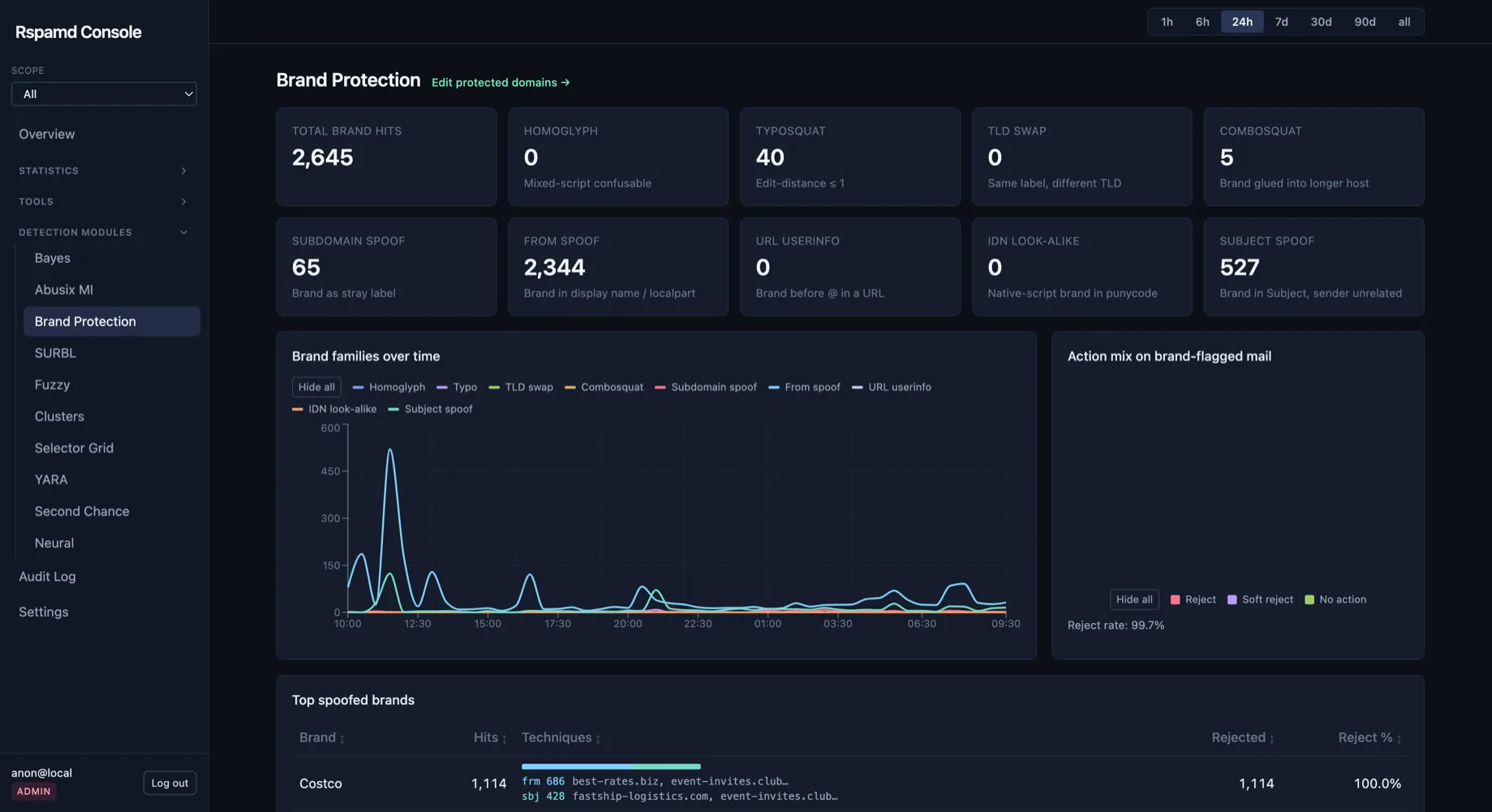
    Brand Protection detects impersonation attacks that generic filters miss. Working from a brand list you curate, it covers the full range of impersonation tactics — from look-alike domains to display-name and subject-line spoofing — including CJK/Japanese native-script variants that Western-centric tools overlook.

    The display-name and subject-line brand abuse that dominates real phishing gets caught. On live traffic, From-display-name spoofing alone out-volumes all domain-squatting techniques combined by ~40×.

    What question it answers

    Who's impersonating our brands? Are display-name attacks hitting us? What's the volume of CJK brand abuse?

    Brand Protection answers these questions with a purpose-built detector that understands the tricks attackers use — and the language-specific variations that Western-centric tools miss.

    Beyond domain watching

    Traditional brand protection watches domain registrars. Real phishing happens in the From display name and subject line — 'Support' as the display name with a random freemail domain, or 'Invoice: ACME Corp' in the subject with no brand reference in the sender.

    These techniques out-volume domain squatting by 40×. Brand Protection catches them.

    Your own name is a brand too

    The brand a BEC crew spoofs most is the recipient's own. Brand Protection derives every recipient's company identity from their domain on the fly — no list to maintain — and flags senders who claim that identity without being it: latin spellings, digit-stripped forms, katakana transliterations, and unicode look-alike dressing included.

    Precision comes from an exception tree, not optimism: mail from the organisation's own domain, its DMARC-aligned senders, operator-listed personal addresses and confirmed in-thread replies are all exempt — and the symbols score as a nudge that combines with other signals, so a real employee writing from a personal mailbox doesn't get nuked.

    Brand claims hidden in images

    With the Vision module, a brand shown only in a message's images — a logo where no text filter can see it — reaches the same decision logic as text-based claims, with exactly the same exception tree. It scores as one combinable signal, not a model verdict.

    When naming another brand is legitimate

    A courier naming the retailer it delivers for is doing its job, not phishing — but whether a courier may speak for a retailer is a fact about the world, not about a message. An operator can mark a domain as authorised to name other brands; the permission only applies to mail that proves it came from that domain, and the suppression is never silent — the message records what would otherwise have been flagged.

    At scale the console asks instead of assuming: when a sender names a brand not its own, the pair is put independently to two AI models from different vendors, and the sender is cleared only when both agree it has standing. A disagreement, a refusal or a failed call leaves the warning in place and puts the pair in front of a person — both answers side by side, in the models' own words. This was measured before it was built: on test sets from two different markets, the two models swapped places exactly, each vouching for fabricated relationships in the market the other knew — and the wrong answers carried the same confidence scores as the right ones. That is why no single model is trusted, why self-reported confidence decides nothing, and why bulk-mail platforms that send for anyone get no standing at all.

    Your own vouch-or-refuse decisions outrank the models permanently and are recorded with who and why. A deployment that has been running for a year owns a brand-relationship list built from its own mail, in its own market — the thing nobody could have shipped to it.
    Brand Protection

    Example: Display-name spoofing at scale

    A financial services customer adds their brand to the protection list. Brand Protection surfaces 15,000 messages with 'Bank of America' in the From display name — but the sender domains are random freemail providers. Domain-based filters miss this entirely. The operator adds the display-name pattern to a map and blocks the entire campaign.
    Premium Neural

    What it does

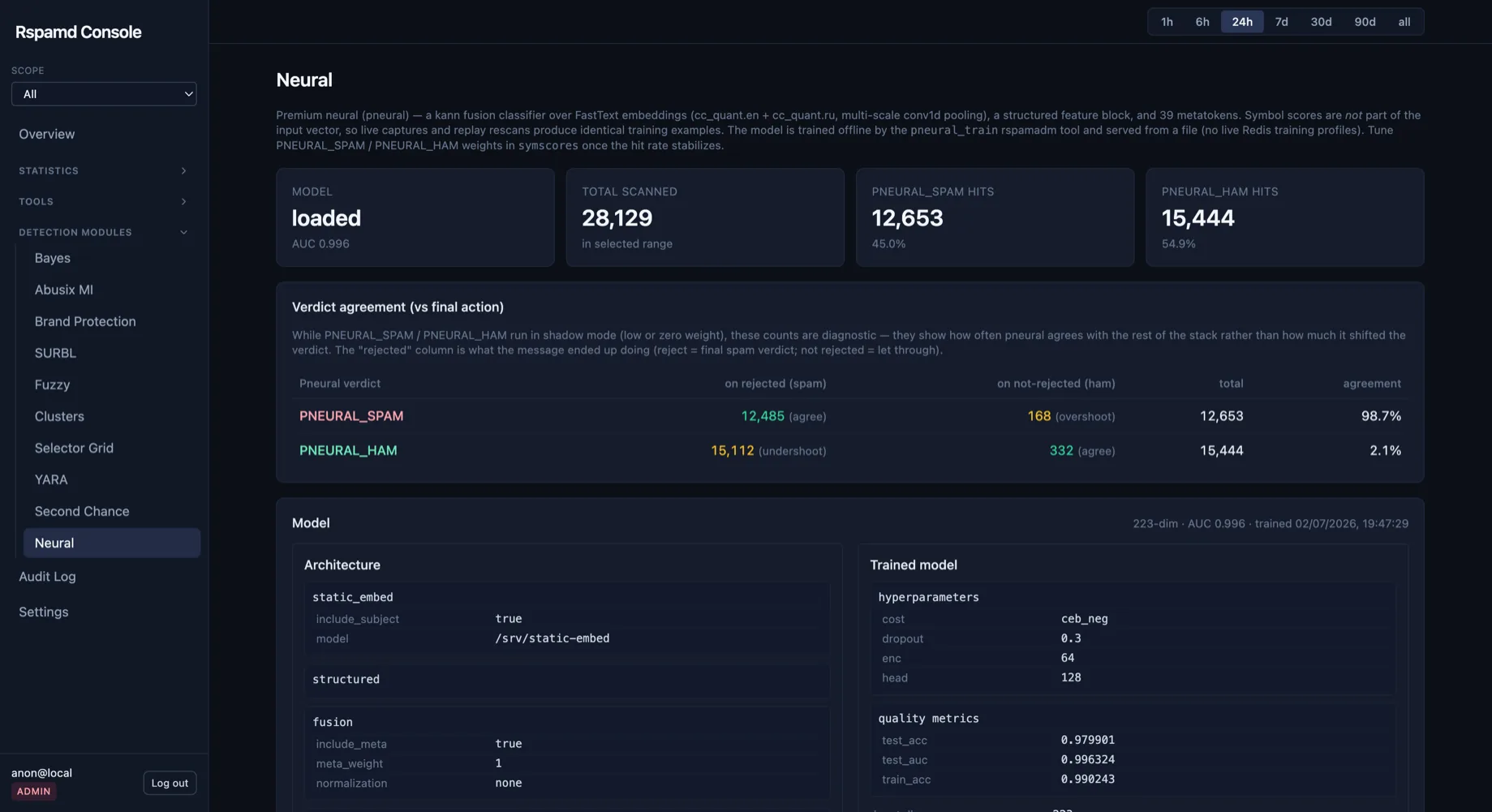
    Rspamd's built-in neural classifier, upgraded into a production-grade detector. It reads each message in context — combining the message text with a rich set of structural and behavioural signals — to make far sharper spam/ham calls than a text-only model.

    ROC AUC 0.998; false positives cut ~20× vs. Bayes and ~11× vs. the OSS text model at the same recall; ~4 ms/message; fully local; CPU-only; no data off-box. Trains online on the customer's own traffic. Multilingual (en/ru/CJK).

    Those figures come from a held-out benchmark corpus. Your own numbers will differ: the Neural panel reports the live model's test AUC for the traffic it was actually trained on.

    What question it answers

    Can I do better than Bayes? What's the cost of this upgrade? Is it worth deploying?

    The benchmark answers: at a fixed aggressive spam-catch rate, Premium neural lets through ~1 false positive for every 20 a Bayes-only setup would. For a busy system that's the difference between 'users trust the filter' and 'users check quarantine by hand.'

    Why it wins

    Generic ML classifiers see only message text. Premium neural reads the message in full context, combining content with a broad set of structural and behavioural signals. That added context is what separates good-enough accuracy from production-grade.

    Premium Neural

    Example: FP reduction at scale

    A deployment processes 2 million messages per day with a Bayes-only classifier. At 95% recall, Bayes produces ~2,400 false positives daily — legitimate mail that users must manually rescue from quarantine. After deploying Premium neural at the same recall, FPs drop to ~120 per day. The team saves hours of user support and quarantine triage every day.

    Vision

    What it does

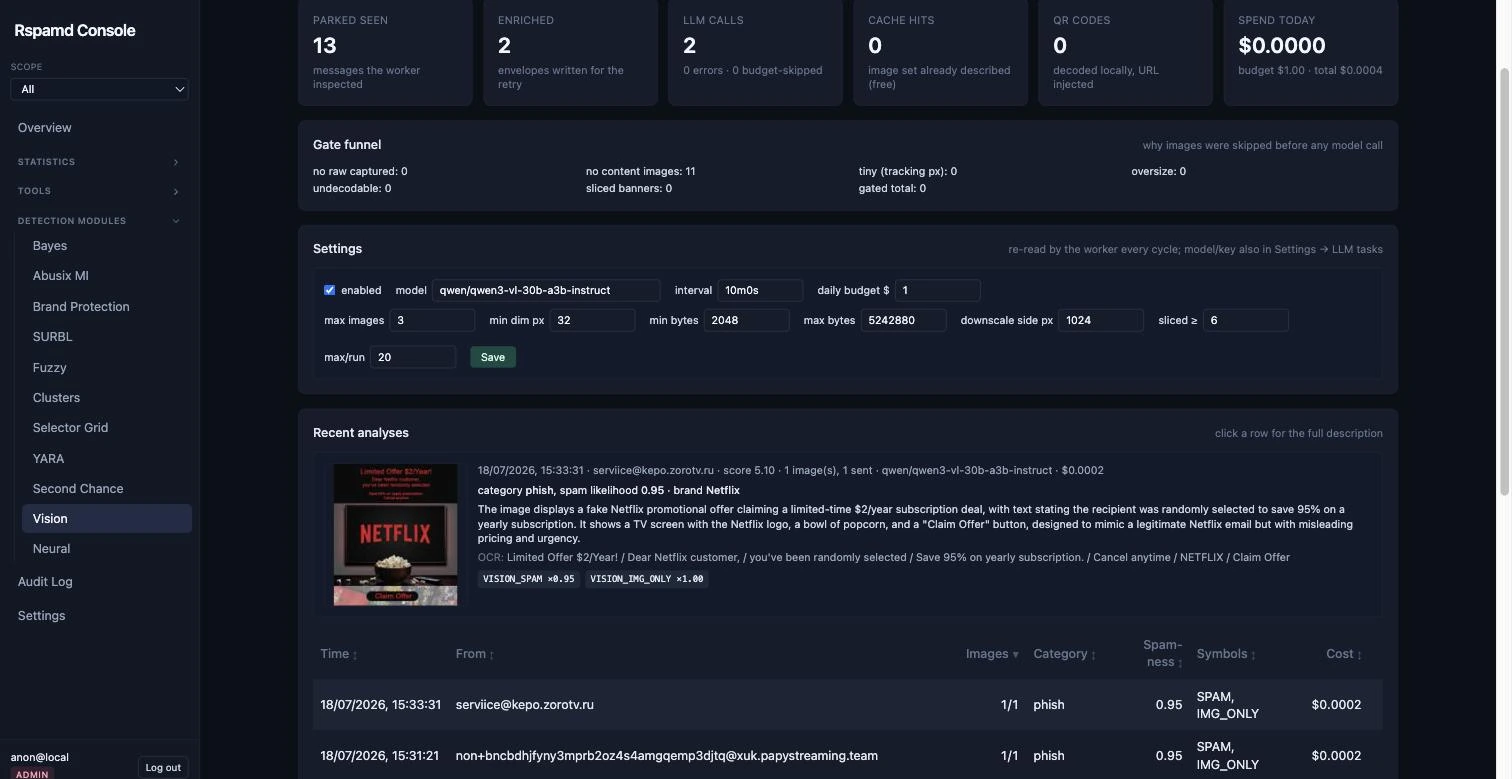
    Spam increasingly hides its payload where text analysis cannot see it: the whole pitch is an image, a QR code, or a banner sliced into tiles. While a borderline message waits out its greylist window, the Vision worker extracts its images, decodes QR codes locally, and has a multimodal model describe what the images actually say — all off the scan path, inside the delay the sender already pays.

    When the sender retries, the message is re-scanned with that description injected as synthetic text parts and URLs, so Bayes, URL rules and language detection finally 'read' the image — and a set of VISION_* symbols joins the verdict. Everything ships in shadow: the symbols start at weight zero and are promoted once their agreement looks right on your own traffic.

    The model sees what the victim sees

    A composition trick — a banner sliced into tiles, a background image with text overlaid, a fake login box drawn in pure HTML with no image part at all — only reads assembled. For such messages the worker composes the mail the way a client would render it and screenshots the result, and that screenshot becomes the primary image the model analyses.

    Rendering happens in an isolated sandbox: scripts never run, and remote content is never fetched by default — so a tracking pixel cannot tell a spammer their mail is being analysed. Renders cost local CPU, not model tokens.

    One call per campaign

    Analysis is cached per unique image set for two weeks, so a blast of thousands of copies costs one model call, and a daily spend budget caps the rest. The deterministic signals — QR decoding, slicing detection — keep working even with the budget exhausted.

    The module page shows the gate funnel (messages with images, passed the gates, analysed), spend against budget, and recent analyses with thumbnails — click one to see the full image the model received. All of it follows the console-wide time picker.

    Vision

    Example: the QR phish that scored zero

    A campaign arrives as a single image: a parking-fine notice with a QR code — no text, no URLs, nothing for a text-based filter to score. The message parks as borderline; Vision decodes the QR locally, the model describes a payment demand impersonating a city authority, and the retry re-scan sees the decoded URL and the description as first-class evidence. The whole blast is covered by that one analysis.

    YARA

    What it does

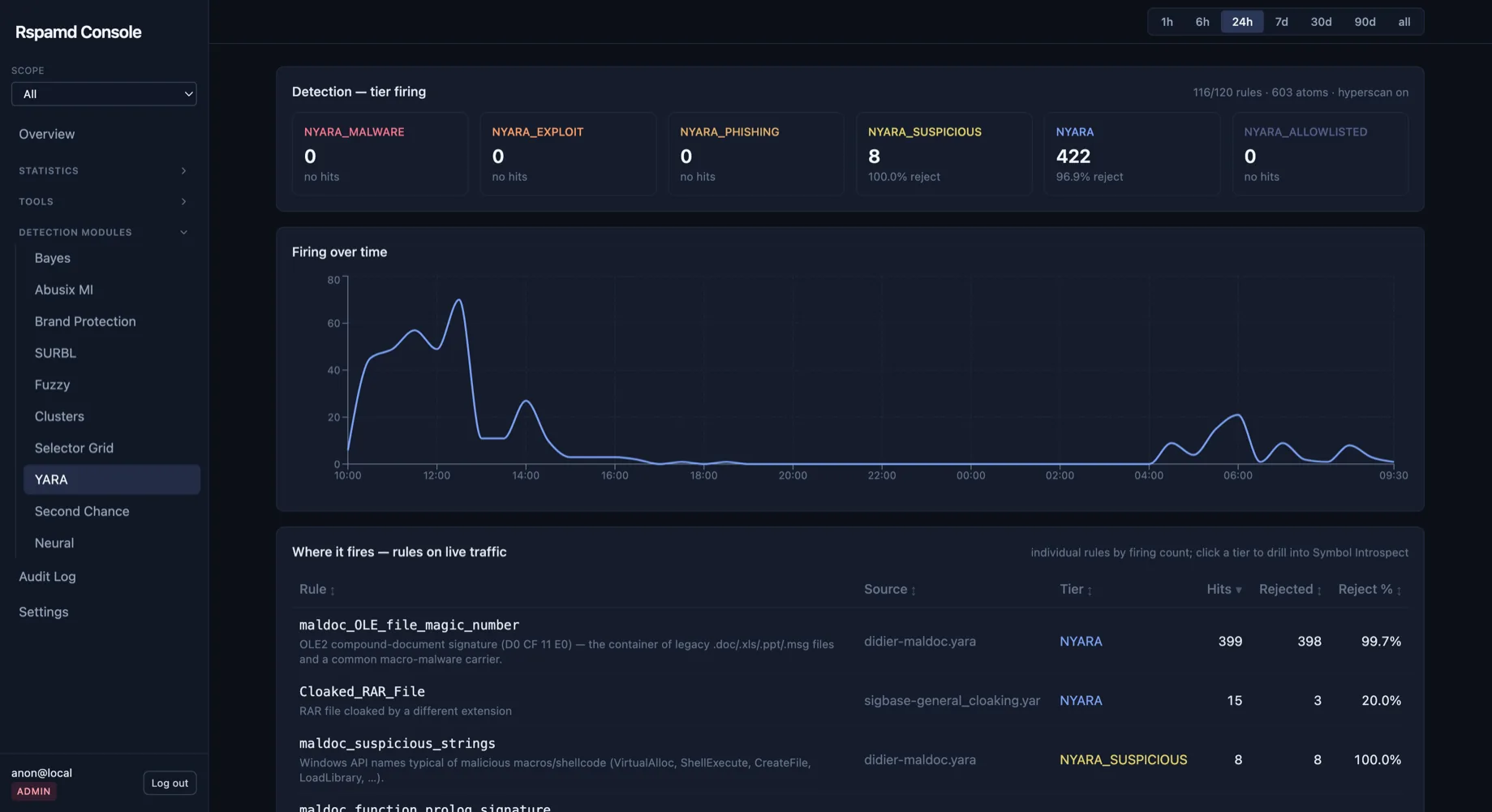
    A dashboard over YARA rule scanning of message content and attachments, tiered by what a rule is looking for: malware, exploit, phishing, generically suspicious, and an allowlist tier that suppresses known-good matches.

    Each tier reports hits and the percentage of those hits that ended in a reject, so you can see at a glance which tiers are earning their scan time.

    Which rules actually fire

    A published YARA ruleset is mostly dead weight — a handful of rules do nearly all the work. The 'where it fires' table ranks rules on your live traffic by hits, rejects and reject rate, and names the source file each rule came from.

    Every tier links through to Symbol Introspect, so a suspicious rule is one click away from its full operational profile.

    Author, audit, publish

    An operator ruleset editor sits on the same page, appended to the rules shipped with the deployment. Unsupported YARA constructs are skipped rather than fatal, and an Audit pass tells you exactly which rules were skipped before you publish anything.

    A test-scan panel compiles the shipped and draft rules together and scans a sample, so you can confirm a rule matches what you think it matches.

    YARA

    Example: a ruleset you can trust

    An operator imports a public maldoc ruleset — 120 rules. Audit reports that four use unsupported constructs and will be skipped, and that the rest compile. After a week on live traffic the 'where it fires' table shows two rules producing 90% of the hits at a 97% reject rate, and eleven rules that have never fired. The operator keeps the two, drops the eleven, and cuts scan cost without losing a single detection.

    Clusters

    What it does (premium)

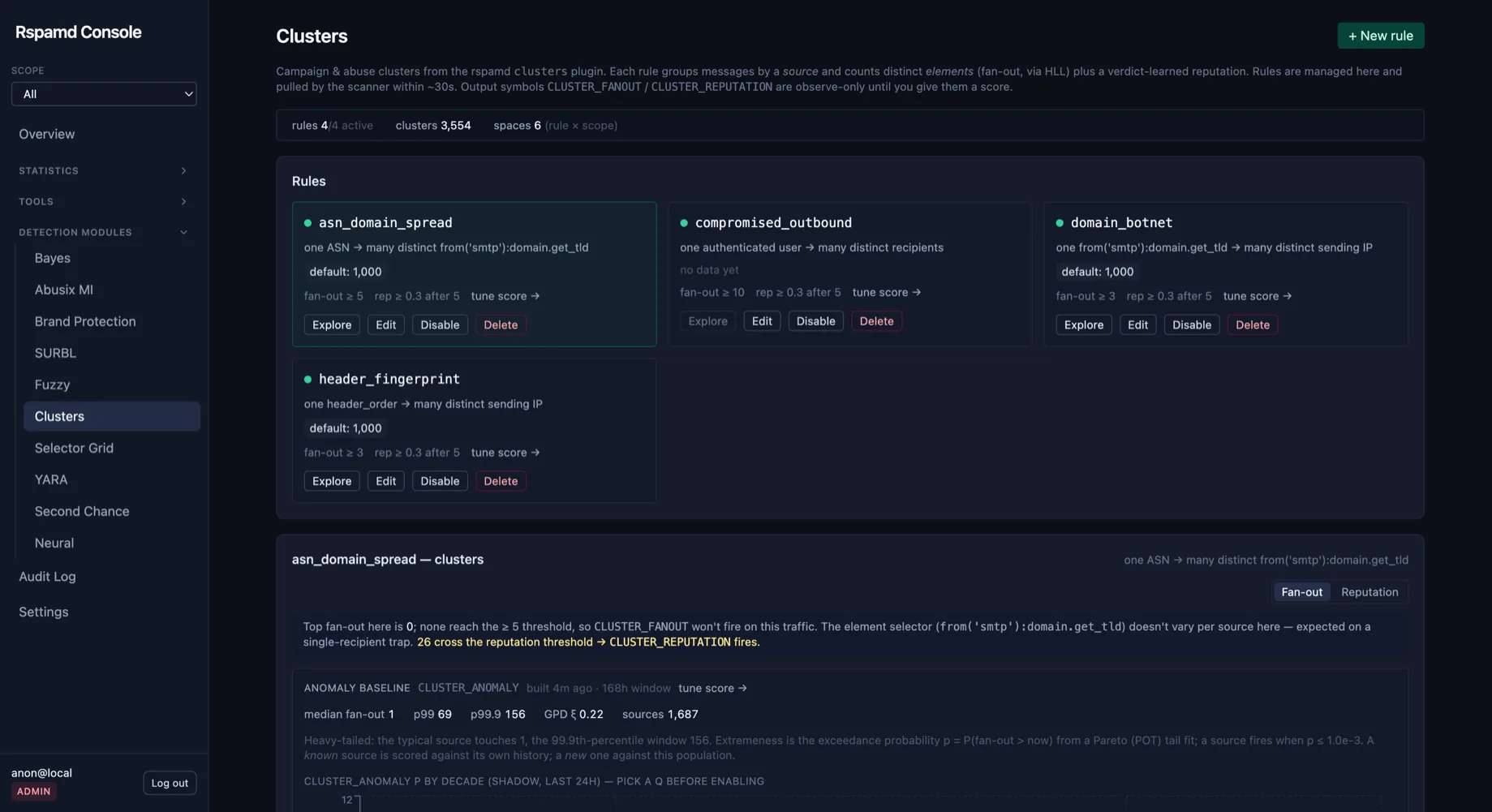
    Operator-defined clustering rules group messages by shared characteristics: ASN, from-domain, header fingerprint, header order, or other lua_selectors. Clusters flag coordinated or botnet-like fanout with symbols CLUSTER_FANOUT, CLUSTER_REPUTATION, and CLUSTER_ANOMALY.

    One-click actions let you block a cluster, capture it for analysis, or train fuzzy across all cluster members. Clusters drive Selector Grid rules — turn a cluster observation into a deployed scoring rule in one click.

    What question it answers

    Is this a coordinated attack? Which messages share this fingerprint? What's the scope of this campaign?

    Clusters reveal patterns that span individual messages: a botnet sending from the same ASN across hundreds of domains, or a phishing kit with a distinctive header order.

    From cluster to rule

    The workflow flows from observation to action: Clusters detects a pattern, you verify it's abuse, click to build a Selector Grid rule from the cluster's selector, and ship it. Minutes from pattern detection to deployed rule.

    Clusters

    Example: Botnet fingerprint

    Clusters surfaces a group of 200 messages sharing a distinctive header order fingerprint and originating from 50 different domains in the same ASN. The CLUSTER_FANOUT symbol fires on all 200. The operator recognises the pattern as a known botnet, clicks 'Block cluster', and the entire ASN is added to a blocklist. All 200 messages are rejected, and future messages from the same fingerprint are blocked.

    Sender Reputation

    What it does (opt-in module)

    Track reputation for senders and domains based on your traffic patterns. See which senders are problematic, which domains are legitimate, and identify emerging threats before they hit your filters.

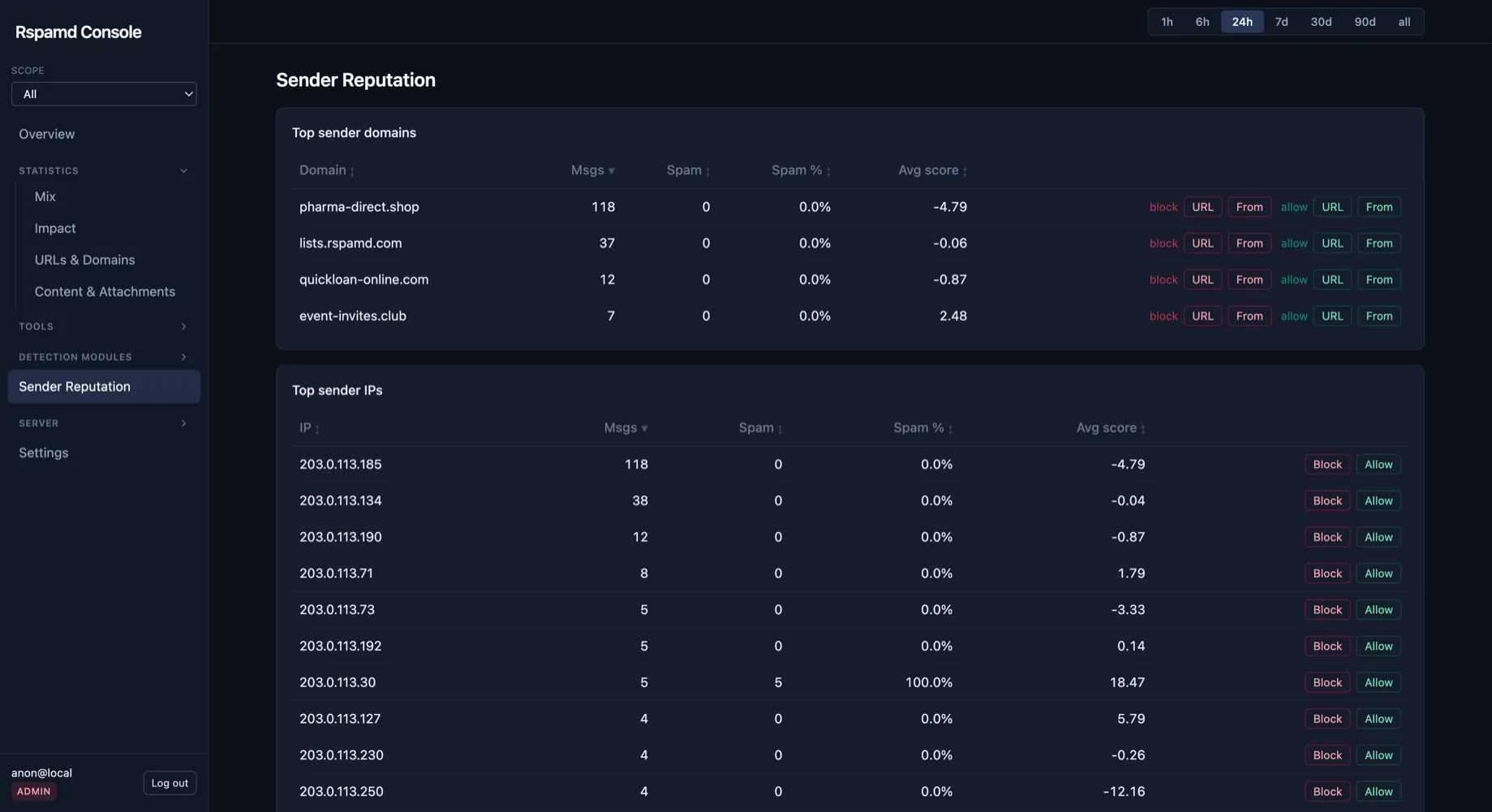
    The reputation panel shows a ranked list of senders and domains with key metrics: average score, spam/ham counts, spam percentage, and message volume. Sort by any column to find the worst offenders.

    Act on a row

    Every row carries Block and Allow buttons, split by target: on a domain row you can act on the URL domain or the envelope-from independently; IP rows block or allow the address. Each action appends one validated line to the matching operator map, idempotently — no duplicate entries, and the change is live on the next map poll.

    Correspondents: the console remembers who you deal with

    Cold sales outreach is correctly signed, personally addressed, and mechanically identical to a receipt or a bank statement — reading the message harder does not separate them. One question does: have we ever dealt with this sender? The Correspondents tab keeps that answer: for every sender, when they first wrote, how often, over how many distinct days, and how their mail was treated — and, separately, which domains this installation has written to. A lookup box states the relationship in plain sentences.

    A sender is identified by what they can prove, not what they write in a From line: a validated DKIM identity, an SPF-passing envelope and an unproven claim are three different identities whose histories are never mixed — so an impersonator cannot inherit the reputation of the brand it imitates. The same record read the other way is a warning: an unauthenticated message claiming a domain you actually correspond with is the exact shape of vendor impersonation and invoice fraud, and it is flagged as such.

    A one-click backfill seeds the history from the scan records already in your analytics database, and can be re-run safely — it merges with what has been learned live. Relationship history never blocks or releases mail by itself: it is evidence for review, presented to the AI reviewer as stated facts, and it never overrules blocklists, antivirus or signatures.

    The correspondence graph stays yours

    Who your people talk to is the most sensitive data in the product, and it never leaves your node: it is not shared with the knowledge-sharing hub, it leaves in no report, and the AI reviewer receives derived statements ('known correspondent, 214 messages over 180 days'), never the graph itself. On multi-tenant deployments each tenant has its own graph, separated in the storage layout rather than by a filter that could be forgotten.

    Sender Reputation

    Example: Identifying a problematic sender

    An operator notices a sender domain appearing frequently in the reputation panel with an average score of 8.2 and 85% spam rate across 500+ messages. The panel shows this sender's reputation declining over the past week. The operator uses this data to decide whether to block the domain or adjust filter sensitivity.

    Bayes Classifier

    What it does

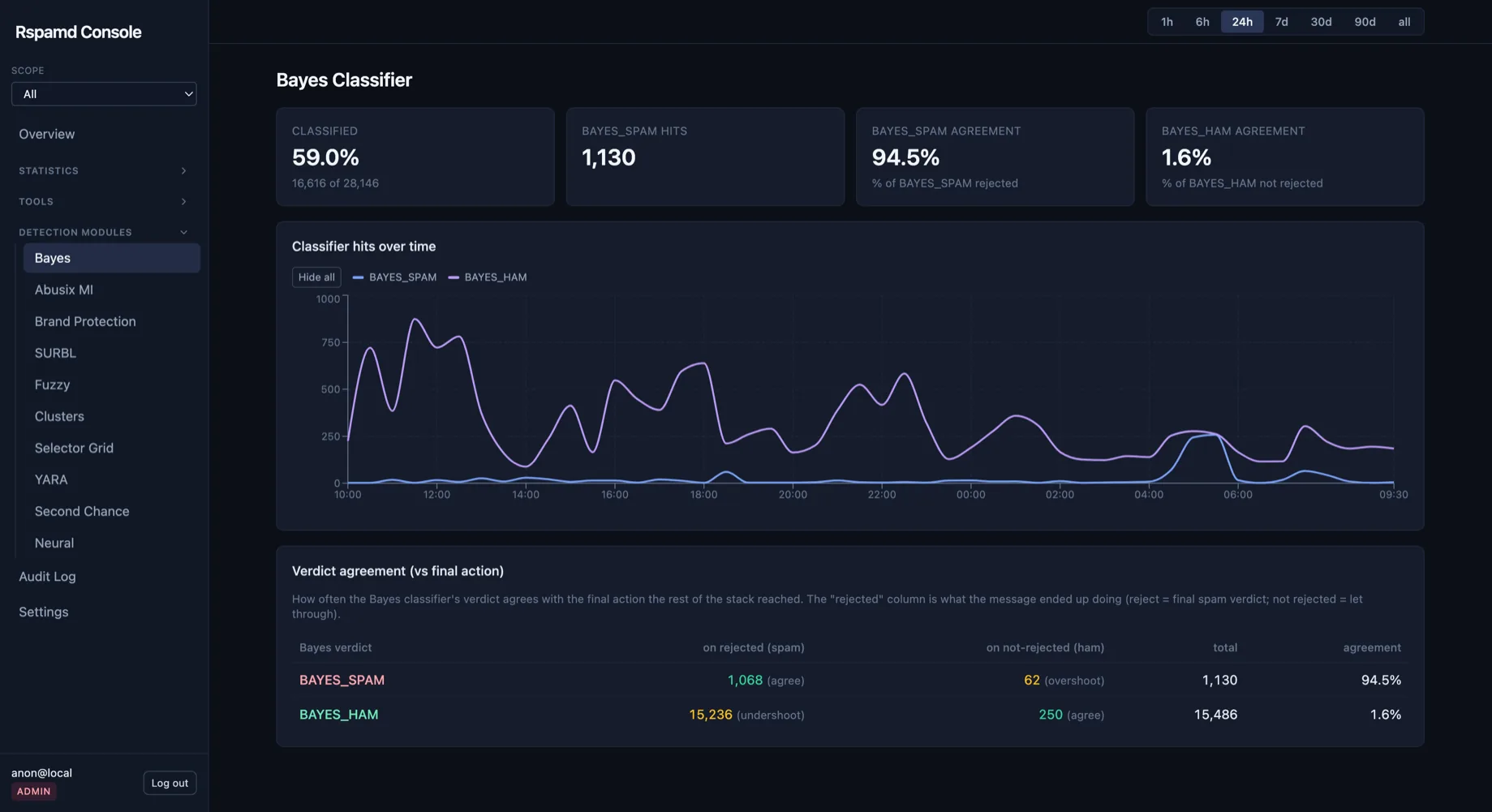
    The Bayes Classifier panel shows the health of your Bayes statistical classifiers: hit rates, score distribution, and training balance.

    Monitor classifier drift, verify learning is working, and ensure your spam/ham training data stays balanced.

    What question it answers

    Is Bayes firing? What's the score distribution? Is our training balanced?

    Bayes health checks ensure your statistical classifier is contributing to verdicts rather than sitting dormant.

    Classifier health

    A Bayes classifier that never fires or always scores zero isn't learning. The panel surfaces these issues so you can fix the underlying problem: missing learn tokens, imbalanced training, or misconfigured thresholds.

    Bayes Classifier

    Example: Detecting a silent Bayes

    The Bayes Classifier panel shows hit rate near zero and scores clustered around zero — the classifier isn't contributing. Investigation reveals that learn tokens are being written to the wrong database. Fixing the path restores Bayes to normal hit rates within 24 hours.

    Vendor Feed Dashboards

    What it does

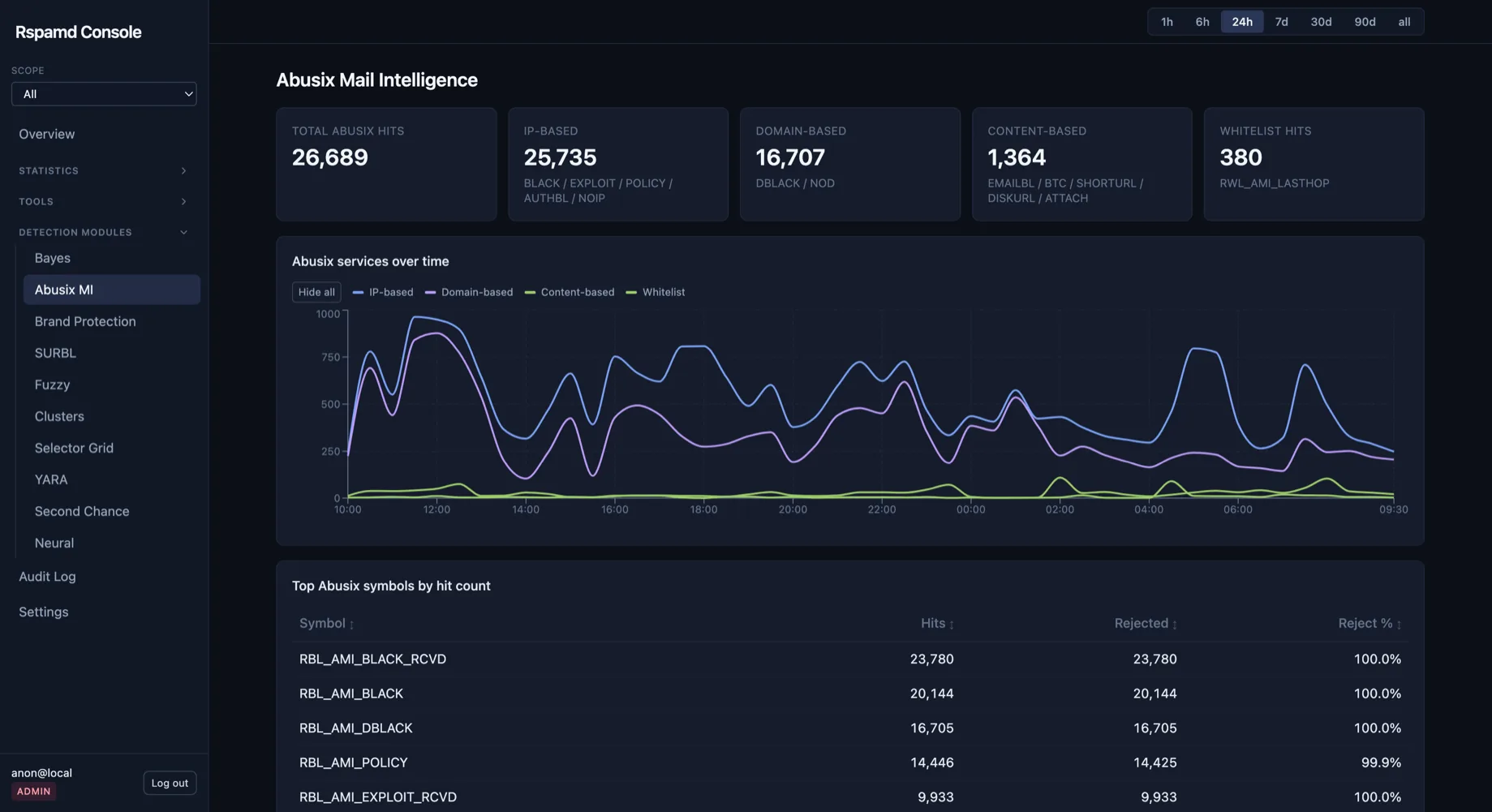
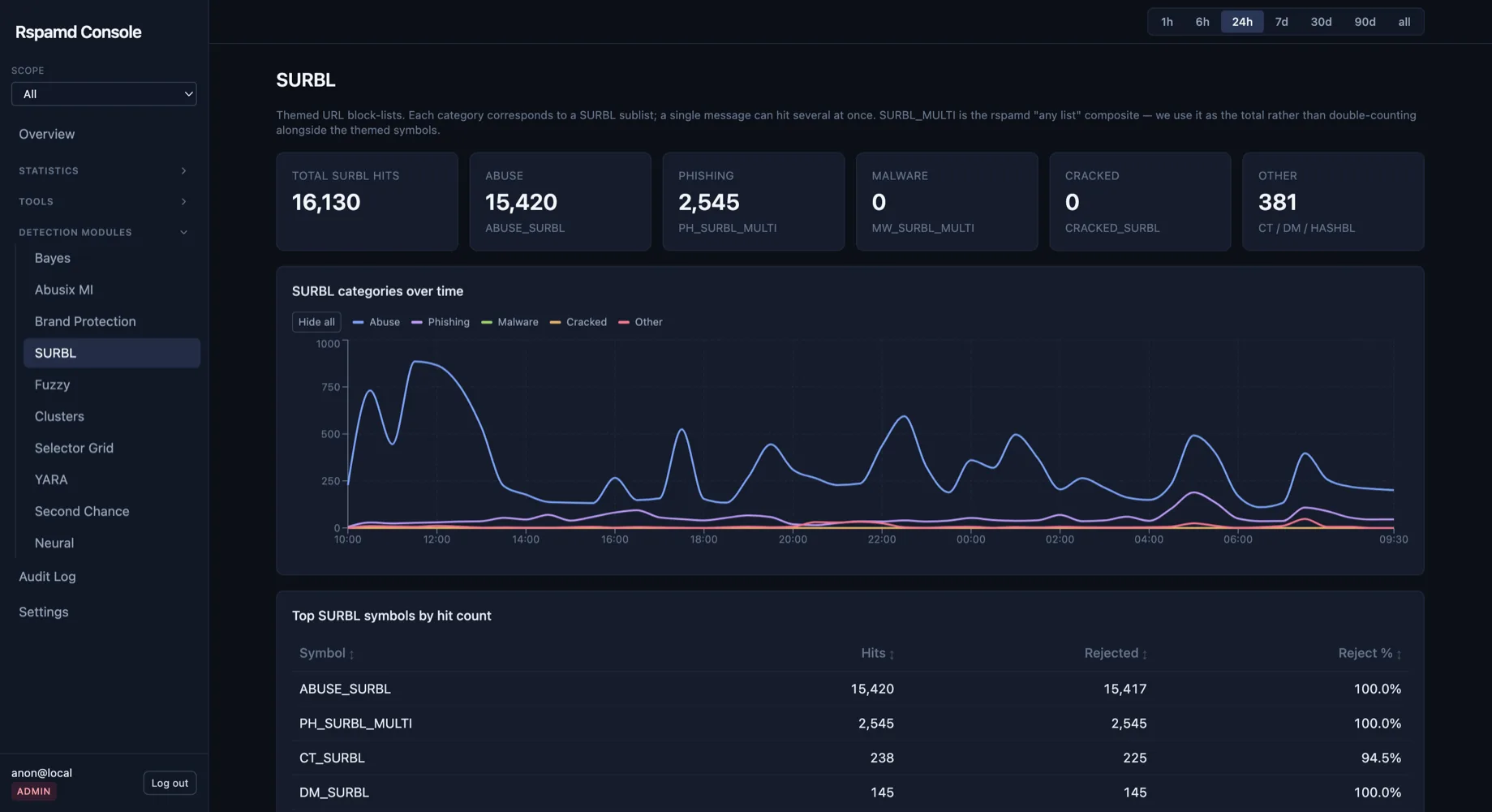
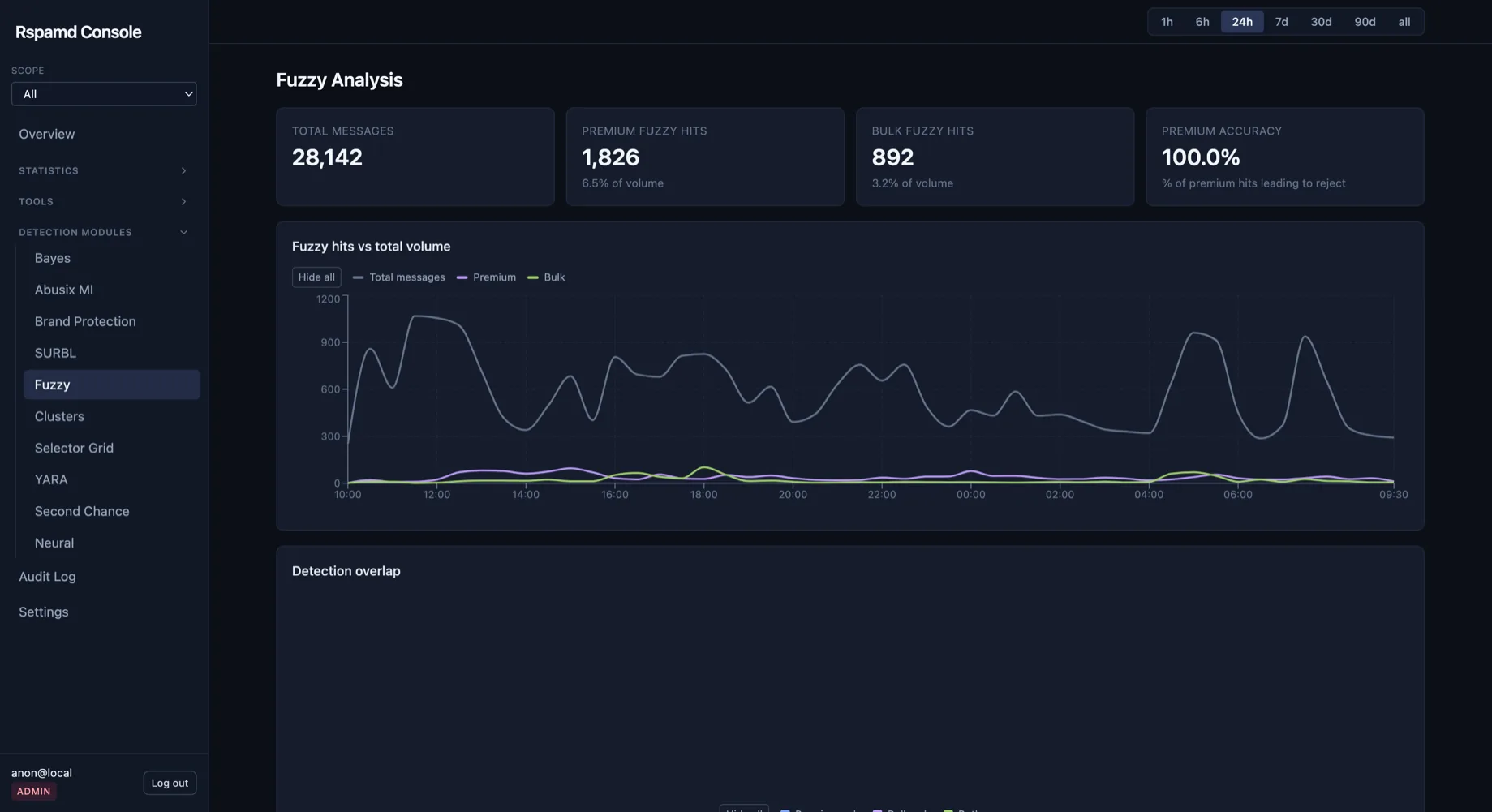
    A dashboard per subscription — Spamhaus DQS, Abusix Mail Intelligence, SURBL and Fuzzy — each breaking the feed down by sub-service rather than reporting one hit count. See which parts of a feed you are paying for and which parts fire.

    Fuzzy compares premium and bulk sources with an overlap view and a premium-accuracy card, so the question 'is the premium tier adding anything?' has an answer.

    What question it answers

    Which sub-services of this subscription actually contribute? Are two feeds telling us the same thing?

    Pair these with Detection Impact: a feed with wide coverage but no decisive contribution is a renewal you can reconsider.

    Vendor Feed Dashboards 1
    Vendor Feed Dashboards 2
    Vendor Feed Dashboards 3
    Vendor Feed Dashboards

    URLs & Domains

    What it does

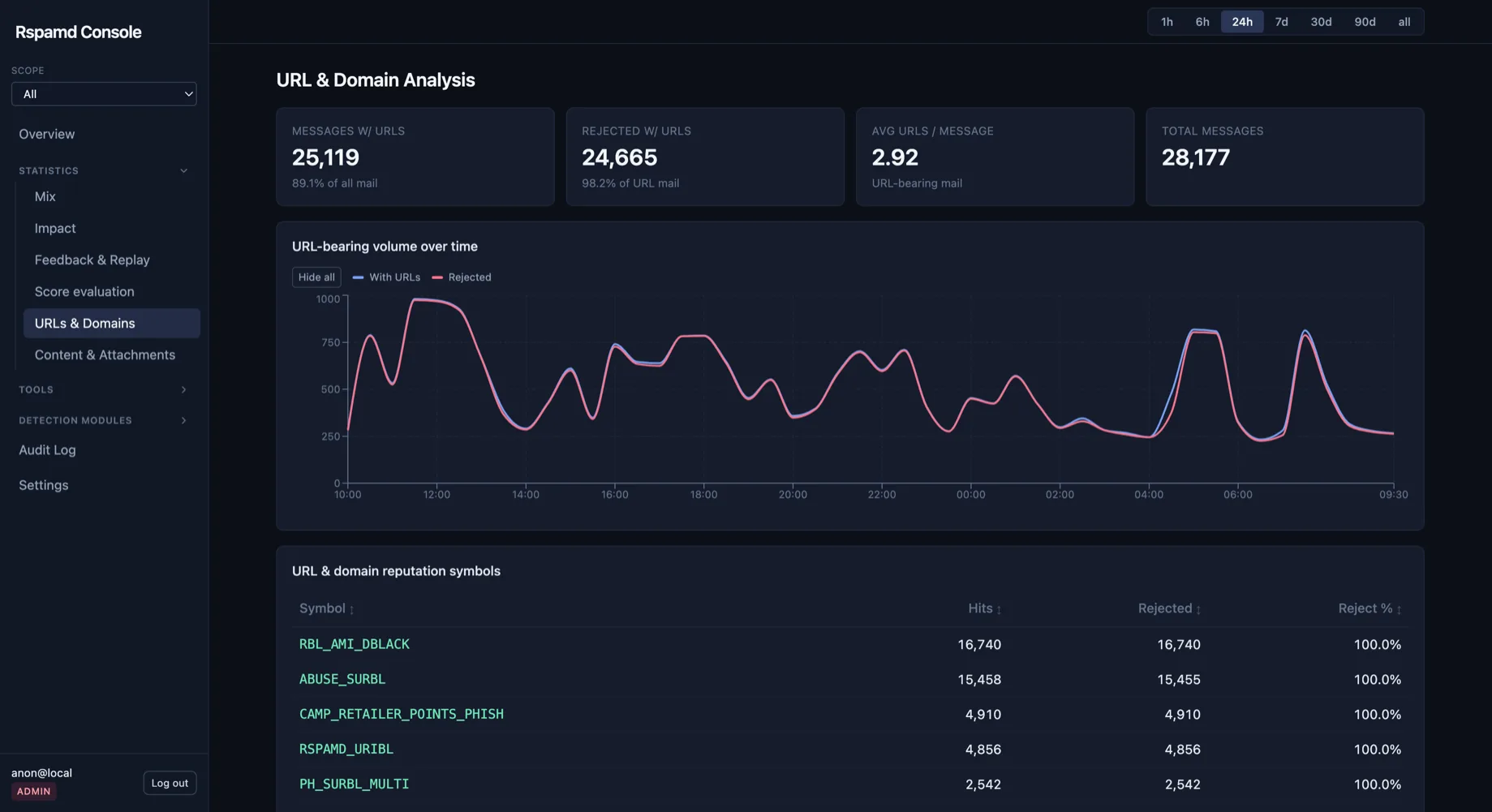
    The URLs & Domains panel provides URL and domain analytics: most-seen domains, TLD distribution, and URL blocklist hit rates.

    See which domains are appearing in your traffic, which TLDs are overrepresented in spam, and how your URL blocklists are performing.

    What question it answers

    Which domains appear most in our mail? What's the top TLD for spam? Are our URL blocklists firing?

    URL and domain analytics help you identify abuse patterns and evaluate the effectiveness of your URL-based detection layers.

    Blocklist performance

    See hit rates for SURBL, Spamhaus DQS, and other URL blocklists. Identify which lists are contributing and which are redundant with your existing rules.

    URLs & Domains

    Example: TLD-based abuse pattern

    The URLs & Domains panel shows certain TLDs appearing in 15% of spam messages but only 2% of ham. The operator adds a mild score adjustment for new registrations in these TLDs and sees spam catch rates improve without affecting legitimate mail from established senders.

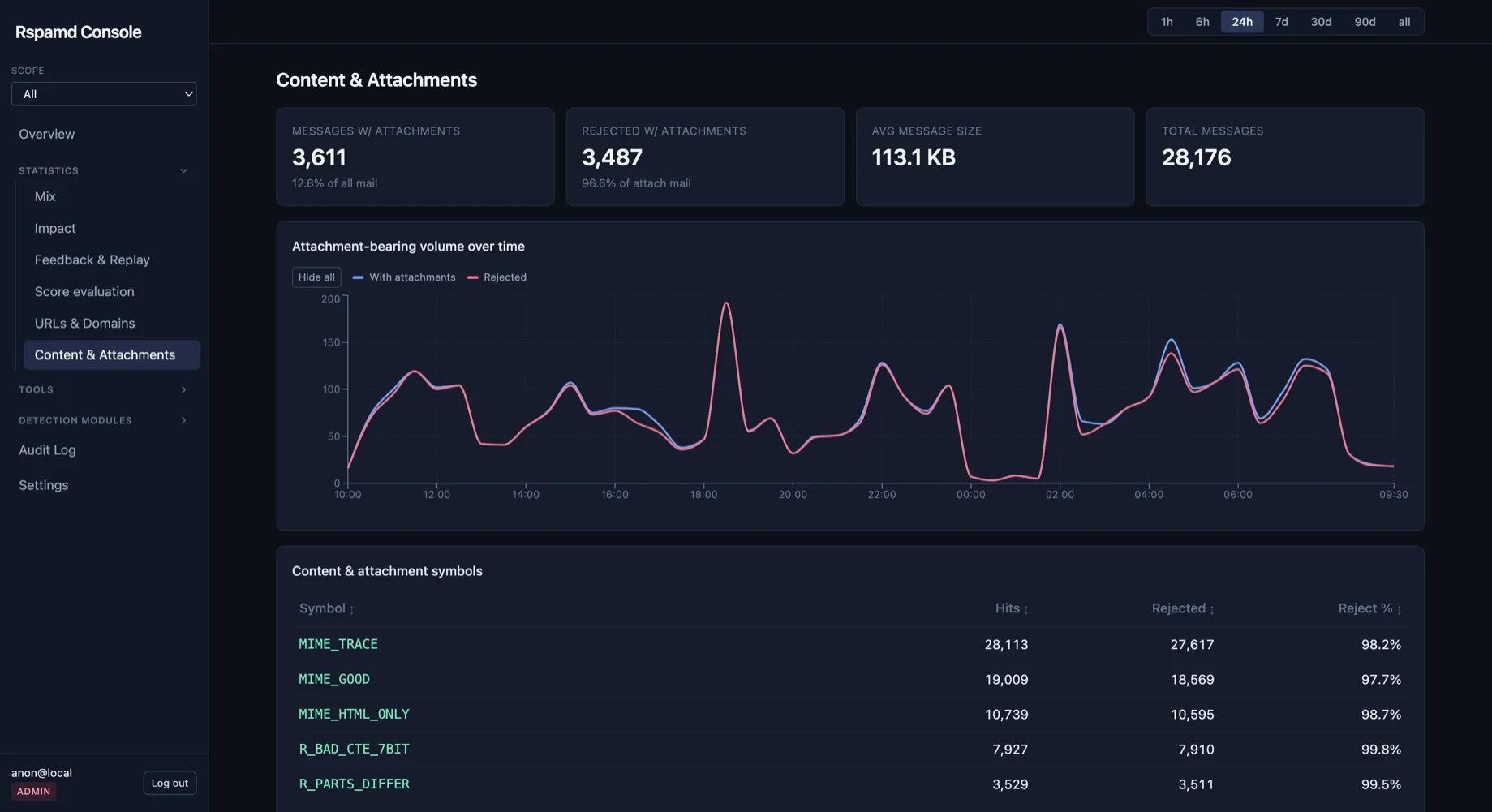
    Content & Attachments

    What it does

    The Content & Attachments panel analyses MIME structure, content-type distribution, and attachment patterns across your traffic. See which file types are being sent, which content rules are firing, and how attachment patterns correlate with spam.

    Track attachment volume by type, document format trends, and content-rule hit rates.

    What question it answers

    What attachment types are most common? Are PDFs correlated with spam? Which content rules are firing?

    Content analytics help you understand the makeup of your email stream and tune content-based detection rules.

    Attachment risk signals

    See which attachment types are overrepresented in spam: executables, archives, office documents with macros. Use this data to tune attachment-based scoring rules.

    Content & Attachments

    Example: Attachment-based threat detection

    The Content & Attachments panel shows a spike in .zip attachments with embedded executables — all classified as spam. The operator adds a content rule to flag password-protected archives and zip files containing PE binaries. The rule catches 200 similar messages in the first hour after deployment.

    Ready to see it on your own traffic?